Java Spring Rest Client Post Example
1- Objective of Example
This document is based on:
- Spring Boot 2.x
- RestTemplate
- Eclipse 3.7
In this post, I will guide you for creating aRestful Client application using Spring Boot with the 4 functions:
- Create a request with GET method, and send it to Restful Web Service to receive a list of employees, or an employment's information. The data received is in XML format orJSON format.
- Create a request with PUT method, and send it to Restful Web Service to ask to edit the information of an employment. The data attached to the request is inXML format orJSON format.
- Create a request withPOST method and send it to Restful Web Service to create a new employee. The data attached to the request is inXML format orJSON format.
- Create a request withDELETE method, and send it to Restful Web Service to delete an employee.
This post uses theRestful Web Service created from the following example:
The RestTemplate class is the central class in Spring Framework for the synchronous calls by the client to access a REST web-service. This class provides the functionality for consuming the REST Services in a easy manner. When using the said class the user has to only provide the URL, the parameters(if any) and extract the results received. The RestTemplate manages the HTTP connections.
2- Create Spring Boot project
On theEclipse, create aSpring Boot project.
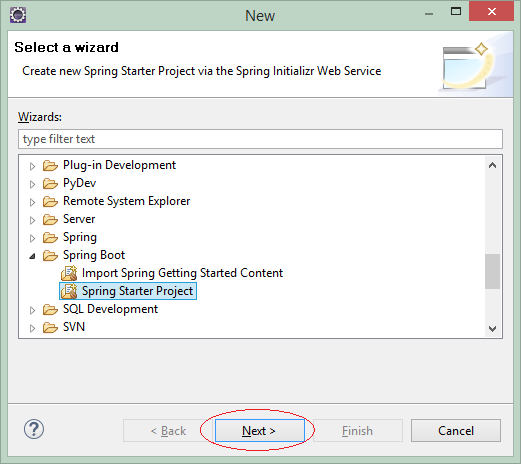
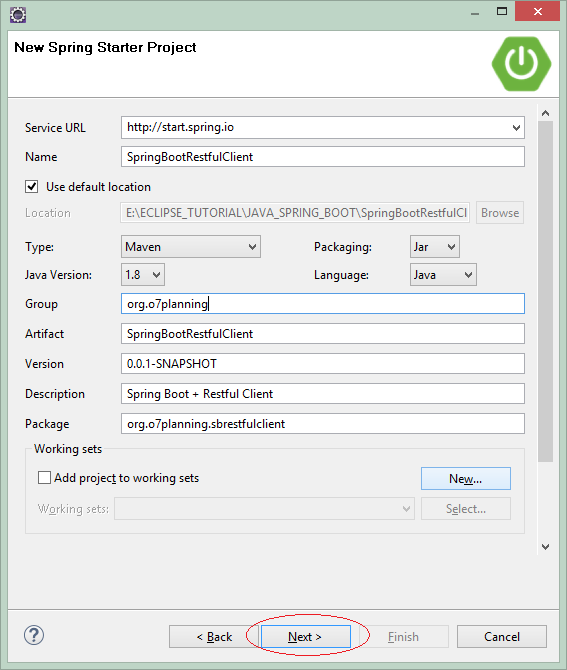
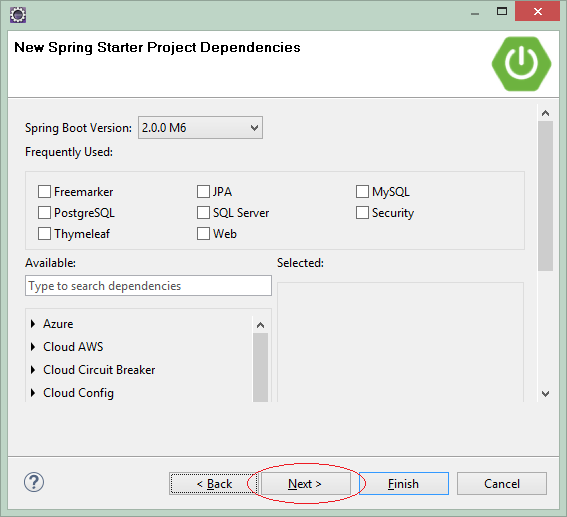
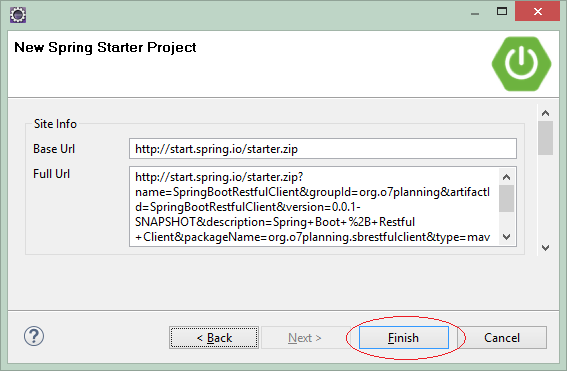
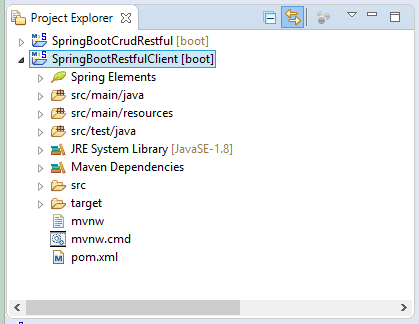
OK, the project has been created.
3- Configure pom.xml
This project needs to use Spring Restful Client libraries. Therefore, you have two choices:
- spring-boot-starter-web
- spring-boot-starter-data-rest
spring-boot-starter-web
spring-boot-starter-web consists of libraries to build a web application using Spring MVC, andtomcat as a default embedded Web Container. It includes libraries for RESTful application.
spring-boot-starter-web
<dependency> <groupId>org.springframework.boot</groupId> <artifactId>spring-boot-starter-web</artifactId> </dependency> spring-boot-starter-data-rest
The spring-boot-starter-data-rest includes libraries to work with Spring RESTful.
spring-boot-starter-data-rest
<!-- https://mvnrepository.com/artifact/org.springframework.boot/spring-boot-starter-data-rest --> <dependency> <groupId>org.springframework.boot</groupId> <artifactId>spring-boot-starter-data-rest</artifactId> </dependency> Java <==> JSON
Both the above"Starters" contain ajackson-databind library to support conversion of a Java object intoJSON and vice versa.
Java <==> XML
Spring uses JAXB (available in JDK) to convert theJava object into XML and vice versa. However, Java classes must be annotated by @XmlRootElement,... Therefore, my advice is that you should use jackson-dataformat-xml as a library to convert XML and Java. To use thejackson-dataformat-xml, you need to declare it in pom.xml file:
jackson-dataformat-xml
<dependency> <groupId>com.fasterxml.jackson.dataformat</groupId> <artifactId>jackson-dataformat-xml</artifactId> </dependency> OK, you have 2 choices to declare in thepom.xml:
** pom.xml (Option 1) **
<dependencies> ...... <dependency> <groupId>org.springframework.boot</groupId> <artifactId>spring-boot-starter-data-rest</artifactId> </dependency> <dependency> <groupId>com.fasterxml.jackson.dataformat</groupId> <artifactId>jackson-dataformat-xml</artifactId> </dependency> ..... </dependencies> ** pom.xml (Option 2) **
<dependencies> ...... <dependency> <groupId>org.springframework.boot</groupId> <artifactId>spring-boot-starter-web</artifactId> </dependency> <dependency> <groupId>com.fasterxml.jackson.dataformat</groupId> <artifactId>jackson-dataformat-xml</artifactId> </dependency> ..... </dependencies> TheApache Commons Codec library is necessary for encoding anusername/password in case, you use Rest Client to access data resources secured byBasic Authentication.
<!-- https://mvnrepository.com/artifact/commons-codec/commons-codec --> <dependency> <groupId>commons-codec</groupId> <artifactId>commons-codec</artifactId> </dependency> The full content of thepom.xml file:
pom.xml
<?xml version="1.0" encoding="UTF-8"?> <project xmlns="http://maven.apache.org/POM/4.0.0" xmlns:xsi="http://www.w3.org/2001/XMLSchema-instance" xsi:schemaLocation="http://maven.apache.org/POM/4.0.0 http://maven.apache.org/xsd/maven-4.0.0.xsd"> <modelVersion>4.0.0</modelVersion> <groupId>org.o7planning</groupId> <artifactId>SpringBootRestfulClient</artifactId> <version>0.0.1-SNAPSHOT</version> <packaging>jar</packaging> <name>SpringBootRestfulClient</name> <description>Spring Boot + Restful Client</description> <parent> <groupId>org.springframework.boot</groupId> <artifactId>spring-boot-starter-parent</artifactId> <version>2.0.0.RELEASE</version> <relativePath/> <!-- lookup parent from repository --> </parent> <properties> <project.build.sourceEncoding>UTF-8</project.build.sourceEncoding> <project.reporting.outputEncoding>UTF-8</project.reporting.outputEncoding> <java.version>1.8</java.version> </properties> <dependencies> <dependency> <groupId>org.springframework.boot</groupId> <artifactId>spring-boot-starter</artifactId> </dependency> <dependency> <groupId>org.springframework.boot</groupId> <artifactId>spring-boot-starter-test</artifactId> <scope>test</scope> </dependency> <dependency> <groupId>org.springframework.boot</groupId> <artifactId>spring-boot-starter-data-rest</artifactId> </dependency> <dependency> <groupId>com.fasterxml.jackson.dataformat</groupId> <artifactId>jackson-dataformat-xml</artifactId> </dependency> <!-- https://mvnrepository.com/artifact/commons-codec/commons-codec --> <dependency> <groupId>commons-codec</groupId> <artifactId>commons-codec</artifactId> </dependency> </dependencies> <build> <plugins> <plugin> <groupId>org.springframework.boot</groupId> <artifactId>spring-boot-maven-plugin</artifactId> </plugin> </plugins> </build> </project> 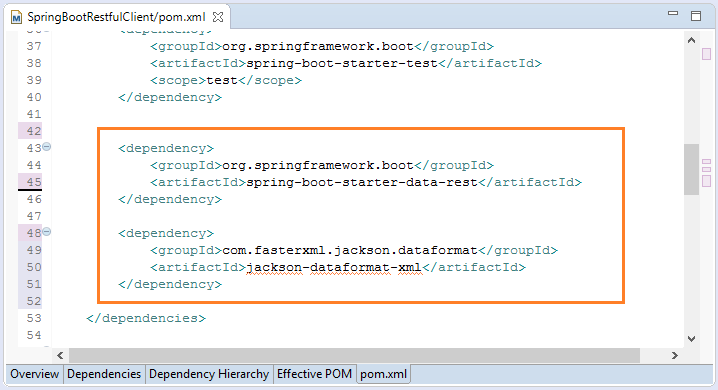
4- GET - getForObject
Use thegetForObject method to send a request to theRestful Service, and receive data returned. Below is the simplest example. The data returned is a string.
SimplestGetExample.java
package org.o7planning.sbrestfulclient.get; import org.springframework.web.client.RestTemplate; public class SimplestGetExample { static final String URL_EMPLOYEES = "http://localhost:8080/employees"; static final String URL_EMPLOYEES_XML = "http://localhost:8080/employees.xml"; static final String URL_EMPLOYEES_JSON = "http://localhost:8080/employees.json"; public static void main(String[] args) { RestTemplate restTemplate = new RestTemplate(); // Send request with GET method and default Headers. String result = restTemplate.getForObject(URL_EMPLOYEES, String.class); System.out.println(result); } } 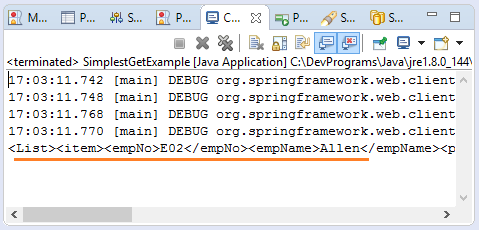
The requests sent to theRestful Service need to customizeHeaders information to tell the Restful Service about the type of data format you want to get (JSON, XML, ...)
GetWithHeaderExample.java
package org.o7planning.sbrestfulclient.get; import java.util.Arrays; import org.springframework.http.HttpEntity; import org.springframework.http.HttpHeaders; import org.springframework.http.HttpMethod; import org.springframework.http.MediaType; import org.springframework.http.ResponseEntity; import org.springframework.web.client.RestTemplate; public class GetWithHeaderExample { static final String URL_EMPLOYEES = "http://localhost:8080/employees"; public static void main(String[] args) { // HttpHeaders HttpHeaders headers = new HttpHeaders(); headers.setAccept(Arrays.asList(new MediaType[] { MediaType.APPLICATION_JSON })); // Request to return JSON format headers.setContentType(MediaType.APPLICATION_JSON); headers.set("my_other_key", "my_other_value"); // HttpEntity<String>: To get result as String. HttpEntity<String> entity = new HttpEntity<String>(headers); // RestTemplate RestTemplate restTemplate = new RestTemplate(); // Send request with GET method, and Headers. ResponseEntity<String> response = restTemplate.exchange(URL_EMPLOYEES, // HttpMethod.GET, entity, String.class); String result = response.getBody(); System.out.println(result); } } 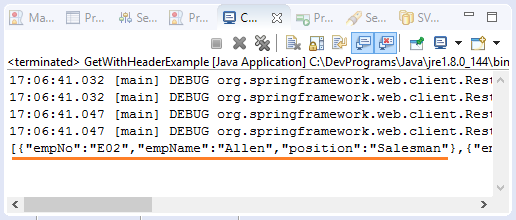
Data returned from RESTful Serivce in XML or JSON format can be automatically converted into a Java object.
Employee.java
package org.o7planning.sbrestfulclient.model; public class Employee { private String empNo; private String empName; private String position; public Employee() { } public Employee(String empNo, String empName, String position) { this.empNo = empNo; this.empName = empName; this.position = position; } public String getEmpNo() { return empNo; } public void setEmpNo(String empNo) { this.empNo = empNo; } public String getEmpName() { return empName; } public void setEmpName(String empName) { this.empName = empName; } public String getPosition() { return position; } public void setPosition(String position) { this.position = position; } } SimplestGetPOJOExample.java
package org.o7planning.sbrestfulclient.get; import org.o7planning.sbrestfulclient.model.Employee; import org.springframework.web.client.RestTemplate; public class SimplestGetPOJOExample { static final String URL_EMPLOYEES = "http://localhost:8080/employees"; static final String URL_EMPLOYEES_XML = "http://localhost:8080/employees.xml"; static final String URL_EMPLOYEES_JSON = "http://localhost:8080/employees.json"; public static void main(String[] args) { RestTemplate restTemplate = new RestTemplate(); // Send request with GET method and default Headers. Employee[] list = restTemplate.getForObject(URL_EMPLOYEES, Employee[].class); if (list != null) { for (Employee e : list) { System.out.println("Employee: " + e.getEmpNo() + " - " + e.getEmpName()); } } } } 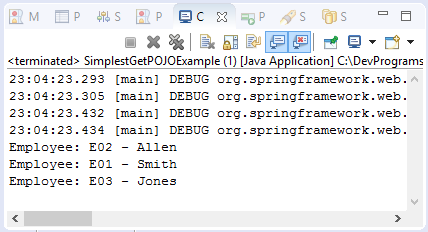
5- GET - exchange
Use exchange method also helps you to be able send a request to theRestful Service. The result returned is ResponseEntityobject. This object contains a lot of noteworthy information, for exampleHttpStatus,...
GetPOJOWithHeaderExample.java
package org.o7planning.sbrestfulclient.get; import java.util.Arrays; import org.o7planning.sbrestfulclient.model.Employee; import org.springframework.http.HttpEntity; import org.springframework.http.HttpHeaders; import org.springframework.http.HttpMethod; import org.springframework.http.HttpStatus; import org.springframework.http.MediaType; import org.springframework.http.ResponseEntity; import org.springframework.web.client.RestTemplate; public class GetPOJOWithHeaderExample { static final String URL_EMPLOYEES = "http://localhost:8080/employees"; public static void main(String[] args) { // HttpHeaders HttpHeaders headers = new HttpHeaders(); headers.setAccept(Arrays.asList(new MediaType[] { MediaType.APPLICATION_XML })); // Request to return XML format headers.setContentType(MediaType.APPLICATION_XML); headers.set("my_other_key", "my_other_value"); // HttpEntity<Employee[]>: To get result as Employee[]. HttpEntity<Employee[]> entity = new HttpEntity<Employee[]>(headers); // RestTemplate RestTemplate restTemplate = new RestTemplate(); // Send request with GET method, and Headers. ResponseEntity<Employee[]> response = restTemplate.exchange(URL_EMPLOYEES, // HttpMethod.GET, entity, Employee[].class); HttpStatus statusCode = response.getStatusCode(); System.out.println("Response Satus Code: " + statusCode); // Status Code: 200 if (statusCode == HttpStatus.OK) { // Response Body Data Employee[] list = response.getBody(); if (list != null) { for (Employee e : list) { System.out.println("Employee: " + e.getEmpNo() + " - " + e.getEmpName()); } } } } } 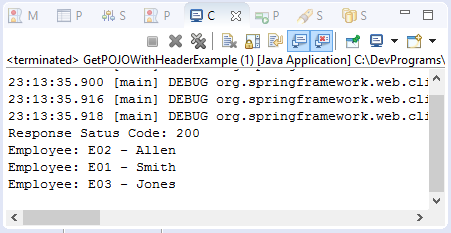
6- GET - Basic Authentication
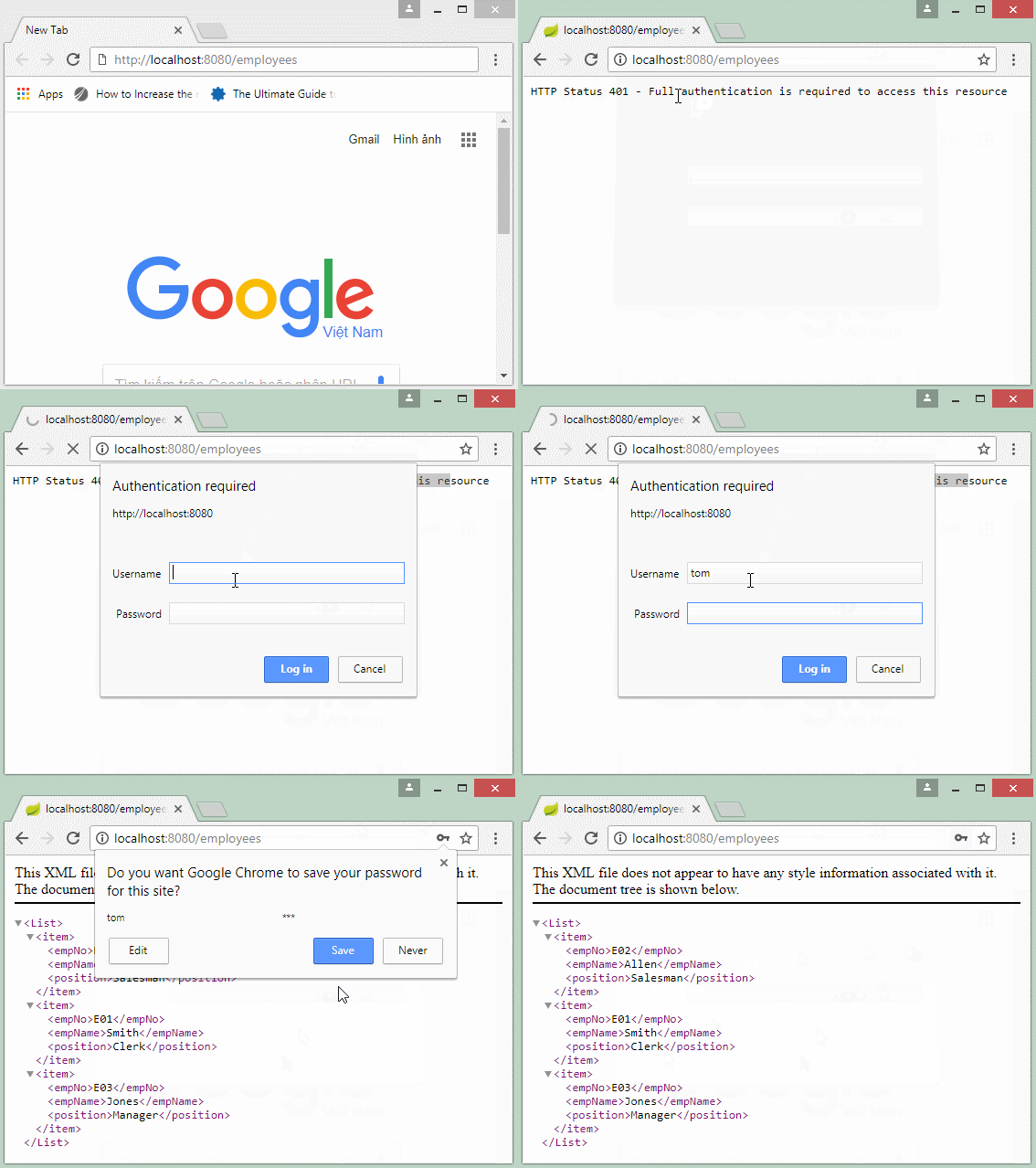
For the data resources secured by theBasic Authentication, the requests sent to REST Service by you must be attached username/password. Theusername/password information needs encoding using theBase64 algorithm before being attached with therequest.
See more:
GetWithBasicAuthExample.java
package org.o7planning.sbrestfulclient.get; import java.nio.charset.Charset; import java.util.Arrays; import org.springframework.http.HttpEntity; import org.springframework.http.HttpHeaders; import org.springframework.http.HttpMethod; import org.springframework.http.MediaType; import org.springframework.http.ResponseEntity; import org.springframework.web.client.RestTemplate; import org.apache.commons.codec.binary.Base64; public class GetWithBasicAuthExample { public static final String USER_NAME = "tom"; public static final String PASSWORD = "123"; static final String URL_EMPLOYEES = "http://localhost:8080/employees"; public static void main(String[] args) { // HttpHeaders HttpHeaders headers = new HttpHeaders(); // // Authentication // String auth = USER_NAME + ":" + PASSWORD; byte[] encodedAuth = Base64.encodeBase64(auth.getBytes(Charset.forName("US-ASCII"))); String authHeader = "Basic " + new String(encodedAuth); headers.set("Authorization", authHeader); // headers.setAccept(Arrays.asList(new MediaType[] { MediaType.APPLICATION_JSON })); // Request to return JSON format headers.setContentType(MediaType.APPLICATION_JSON); headers.set("my_other_key", "my_other_value"); // HttpEntity<String>: To get result as String. HttpEntity<String> entity = new HttpEntity<String>(headers); // RestTemplate RestTemplate restTemplate = new RestTemplate(); // Send request with GET method, and Headers. ResponseEntity<String> response = restTemplate.exchange(URL_EMPLOYEES, // HttpMethod.GET, entity, String.class); String result = response.getBody(); System.out.println(result); } } 7- POST - postForObject
ThepostForObject method is used to send a request to theRestful Service to create a data resource and return the data resource which has just been created.
Post_postForObject_Example.java
package org.o7planning.sbrestfulclient.post; import org.o7planning.sbrestfulclient.model.Employee; import org.springframework.http.HttpEntity; import org.springframework.http.HttpHeaders; import org.springframework.http.MediaType; import org.springframework.web.client.RestTemplate; public class Post_postForObject_Example { static final String URL_CREATE_EMPLOYEE = "http://localhost:8080/employee"; public static void main(String[] args) { String empNo = "E11"; Employee newEmployee = new Employee(empNo, "Tom", "Cleck"); HttpHeaders headers = new HttpHeaders(); headers.add("Accept", MediaType.APPLICATION_XML_VALUE); headers.setContentType(MediaType.APPLICATION_XML); RestTemplate restTemplate = new RestTemplate(); // Data attached to the request. HttpEntity<Employee> requestBody = new HttpEntity<>(newEmployee, headers); // Send request with POST method. Employee e = restTemplate.postForObject(URL_CREATE_EMPLOYEE, requestBody, Employee.class); if (e != null && e.getEmpNo() != null) { System.out.println("Employee created: " + e.getEmpNo()); } else { System.out.println("Something error!"); } } } 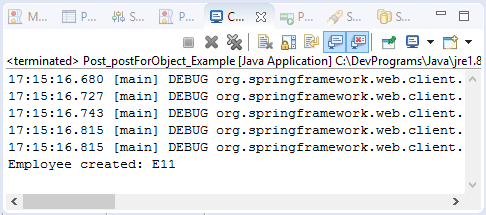
8- POST - postForEntity
ThepostForEntity method is used to send arequest to theRestful Service to create a data resource. This method returns theResponseEntity object. This object contains data resouce which has just been created and other noteworthy information, for example, HttpStatus, ...
Post_postForEntity_Example.java
package org.o7planning.sbrestfulclient.post; import org.o7planning.sbrestfulclient.model.Employee; import org.springframework.http.HttpEntity; import org.springframework.http.HttpStatus; import org.springframework.http.ResponseEntity; import org.springframework.web.client.RestTemplate; public class Post_postForEntity_Example { static final String URL_CREATE_EMPLOYEE = "http://localhost:8080/employee"; public static void main(String[] args) { Employee newEmployee = new Employee("E11", "Tom", "Cleck"); RestTemplate restTemplate = new RestTemplate(); // Data attached to the request. HttpEntity<Employee> requestBody = new HttpEntity<>(newEmployee); // Send request with POST method. ResponseEntity<Employee> result = restTemplate.postForEntity(URL_CREATE_EMPLOYEE, requestBody, Employee.class); System.out.println("Status code:" + result.getStatusCode()); // Code = 200. if (result.getStatusCode() == HttpStatus.OK) { Employee e = result.getBody(); System.out.println("(Client Side) Employee Created: "+ e.getEmpNo()); } } } 9- PUT - Simple Example
Theput method of theRestTemplate class is used to send a request to theRestful Service to change a data resource. This method returns nothing.
PutSimpleExample.java
package org.o7planning.sbrestfulclient.put; import org.o7planning.sbrestfulclient.model.Employee; import org.springframework.http.HttpEntity; import org.springframework.http.HttpHeaders; import org.springframework.http.MediaType; import org.springframework.web.client.RestTemplate; public class PutSimpleExample { static final String URL_UPDATE_EMPLOYEE = "http://localhost:8080/employee"; static final String URL_EMPLOYEE_PREFIX = "http://localhost:8080/employee"; public static void main(String[] args) { String empNo = "E01"; Employee updateInfo = new Employee(empNo, "Tom", "Cleck"); HttpHeaders headers = new HttpHeaders(); headers.add("Accept", MediaType.APPLICATION_JSON_VALUE); RestTemplate restTemplate = new RestTemplate(); // Data attached to the request. HttpEntity<Employee> requestBody = new HttpEntity<>(updateInfo, headers); // Send request with PUT method. restTemplate.put(URL_UPDATE_EMPLOYEE, requestBody, new Object[] {}); String resourceUrl = URL_EMPLOYEE_PREFIX + "/" + empNo; Employee e = restTemplate.getForObject(resourceUrl, Employee.class); if (e != null) { System.out.println("(Client side) Employee after update: "); System.out.println("Employee: " + e.getEmpNo() + " - " + e.getEmpName()); } } } 10- PUT - exchange
Example of using theexchange method of theRestTemplate class to send a request to theRestful Service to change a data resource.
PutWithExchangeExample.java
package org.o7planning.sbrestfulclient.put; import org.o7planning.sbrestfulclient.model.Employee; import org.springframework.http.HttpEntity; import org.springframework.http.HttpHeaders; import org.springframework.http.HttpMethod; import org.springframework.http.MediaType; import org.springframework.web.client.RestTemplate; public class PutWithExchangeExample { static final String URL_UPDATE_EMPLOYEE = "http://localhost:8080/employee"; static final String URL_EMPLOYEE_PREFIX = "http://localhost:8080/employee"; public static void main(String[] args) { String empNo = "E01"; Employee updateInfo = new Employee(empNo, "Tom", "Cleck"); HttpHeaders headers = new HttpHeaders(); headers.add("Accept", MediaType.APPLICATION_JSON_VALUE); RestTemplate restTemplate = new RestTemplate(); // Data attached to the request. HttpEntity<Employee> requestBody = new HttpEntity<>(updateInfo, headers); // Send request with PUT method. restTemplate.exchange(URL_UPDATE_EMPLOYEE, HttpMethod.PUT, requestBody, Void.class); String resourceUrl = URL_EMPLOYEE_PREFIX + "/" + empNo; Employee e = restTemplate.getForObject(resourceUrl, Employee.class); if (e != null) { System.out.println("(Client side) Employee after update: "); System.out.println("Employee: " + e.getEmpNo() + " - " + e.getEmpName()); } } } 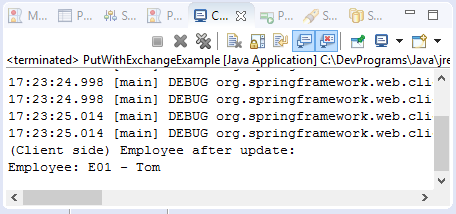
11- DELELE
Use thedelete method of theRestTemplate class to send a request to theRestful Service to delete a data resource.
DeleteSimpleExample.java
package org.o7planning.sbrestfulclient.delete; import org.o7planning.sbrestfulclient.model.Employee; import org.springframework.web.client.RestTemplate; public class DeleteSimpleExample { public static void main(String[] args) { RestTemplate restTemplate = new RestTemplate(); // empNo="E01" String resourceUrl = "http://localhost:8080/employee/E01"; // Send request with DELETE method. restTemplate.delete(resourceUrl); // Get Employee e = restTemplate.getForObject(resourceUrl, Employee.class); if (e != null) { System.out.println("(Client side) Employee after delete: "); System.out.println("Employee: " + e.getEmpNo() + " - " + e.getEmpName()); } else { System.out.println("Employee not found!"); } } } DeleteExample2.java
package org.o7planning.sbrestfulclient.delete; import org.o7planning.sbrestfulclient.model.Employee; import org.springframework.web.client.RestTemplate; public class DeleteExample2 { public static void main(String[] args) { RestTemplate restTemplate = new RestTemplate(); // URL with URI-variable String resourceUrl = "http://localhost:8080/employee/{empNo}"; Object[] uriValues = new Object[] { "E01" }; // Send request with DELETE method. restTemplate.delete(resourceUrl, uriValues); Employee e = restTemplate.getForObject(resourceUrl, Employee.class); if (e != null) { System.out.println("(Client side) Employee after delete: "); System.out.println("Employee: " + e.getEmpNo() + " - " + e.getEmpName()); } else { System.out.println("Employee not found!"); } } } Source: https://o7planning.org/11647/spring-boot-restful-client-with-resttemplate
0 Response to "Java Spring Rest Client Post Example"
Post a Comment