Which Statement Is Not Correct About Academic Art in 19thcentury France?


Academic art, or academicism or academism, is a style of painting and sculpture produced nether the influence of European academies of art. Specifically, academic art is the art and artists influenced by the standards of the French Académie des Beaux-Arts, which was skilful under the movements of Neoclassicism and Romanticism, and the art that followed these two movements in the try to synthesize both of their styles, and which is best reflected by the paintings of William-Adolphe Bouguereau, Thomas Couture, and Hans Makart. In this context it is oftentimes chosen "academism," "academicism," "fine art pompier" (pejoratively), and "eclecticism," and sometimes linked with "historicism" and "syncretism." Academic art is closely related to Beaux-Arts compages, which developed in the same identify and holds to a like classicizing platonic.
The academies in history [edit]
The outset academy of fine art was founded in Florence in Italia by Cosimo I de' Medici, on 13 January 1563, under the influence of the architect Giorgio Vasari who called it the Accademia e Compagnia delle Arti del Disegno (Academy and Company for the Arts of Drawing) equally it was divided in two dissimilar operative branches. While the Company was a kind of corporation which every working artist in Tuscany could join, the Academy comprised only the most eminent creative personalities of Cosimo'south court, and had the task of supervising the whole creative production of the Medicean country. In this Medicean institution students learned the "arti del disegno" (a term coined by Vasari) and heard lectures on anatomy and geometry. Some other academy, the Accademia di San Luca (named later the patron saint of painters, St. Luke), was founded about a decade later on in Rome. The Accademia di San Luca served an educational role and was more than concerned with art theory than the Florentine one. In 1582 Annibale Carracci opened his very influential University of Desiderosi in Bologna without official back up; in some ways this was more like a traditional artist'due south workshop, but that he felt the need to label information technology as an "academy" demonstrates the attraction of the idea at the time.
Accademia di San Luca later served equally the model for the Académie royale de peinture et de sculpture founded in France in 1648, and which later became the Académie des beaux-arts. The Académie royale de peinture et de sculpture was founded in an endeavour to distinguish artists "who were gentlemen practicing a liberal art" from craftsmen, who were engaged in transmission labor. This accent on the intellectual component of artmaking had a considerable impact on the subjects and styles of bookish art.
Later the Académie royale de peinture et de sculpture was reorganized in 1661 by Louis XIV whose aim was to control all the artistic activity in French republic, a controversy occurred amidst the members that dominated artistic attitudes for the residue of the century. This "boxing of styles" was a conflict over whether Peter Paul Rubens or Nicolas Poussin was a suitable model to follow. Followers of Poussin, called "poussinistes," argued that line (disegno) should dominate art, because of its entreatment to the intellect, while followers of Rubens, called "rubenistes," argued that colour (colore) should dominate art, because of its appeal to emotion.
The debate was revived in the early 19th century, under the movements of Neoclassicism typified by the artwork of Jean Auguste Dominique Ingres, and Romanticism typified by the artwork of Eugène Delacroix. Debates also occurred over whether it was better to learn art past looking at nature, or to learn past looking at the creative masters of the by.
Academies using the French model formed throughout Europe, and imitated the teachings and styles of the French Académie. In England, this was the Royal Academy. The Majestic Danish Academy of Fine Arts founded in 1754, may be taken as a successful instance in a smaller country, which achieved its aim of producing a national schoolhouse and reducing the reliance on imported artists. The painters of the Danish Golden Age of roughly 1800-1850 were nearly all trained there, and many returned to teach and the history of the art of Denmark is much less marked by tension between academic art and other styles than is the case in other countries.
Women artists [edit]
One upshot of the move to academies was to brand training more difficult for women artists, who were excluded from most academies until the last half of the 19th century (1861 for the Royal Academy).[1] [ii] This was partly because of concerns over the perceived impropriety presented by nudity.[1] Special arrangements were sometimes made for female students until the 20th century.[3]
Development of the bookish fashion [edit]
Since the onset of the Poussiniste-Rubeniste debate, many artists worked between the 2 styles. In the 19th century, in the revived form of the debate, the attention and the aims of the art world became to synthesize the line of Neoclassicism with the colour of Romanticism. I artist after another was claimed by critics to have achieved the synthesis, among them Théodore Chassériau, Ary Scheffer, Francesco Hayez, Alexandre-Gabriel Decamps, and Thomas Couture. William-Adolphe Bouguereau, a later academic artist, commented that the play a joke on to being a good painter is seeing "color and line as the same thing." Thomas Couture promoted the aforementioned thought in a book he authored on art method—arguing that whenever 1 said a painting had better color or improve line it was nonsense, because whenever color appeared brilliant information technology depended on line to convey information technology, and vice versa; and that color was really a fashion to talk virtually the "value" of grade.
Another evolution during this catamenia included adopting historical styles in guild to testify the era in history that the painting depicted, called historicism. This is all-time seen in the piece of work of Baron Jan August Hendrik Leys, a later influence on James Tissot. It's too seen in the development of the Neo-Grec manner. Historicism is likewise meant to refer to the belief and practice associated with academic art that i should incorporate and conciliate the innovations of different traditions of fine art from the past.
The fine art globe also grew to requite increasing focus on allegory in fine art. Theories of the importance of both line and color asserted that through these elements an creative person exerts command over the medium to create psychological effects, in which themes, emotions, and ideas tin can be represented. Every bit artists attempted to synthesize these theories in practice, the attention on the artwork as an allegorical or figurative vehicle was emphasized. It was held that the representations in painting and sculpture should evoke Platonic forms, or ethics, where behind ordinary depictions one would glimpse something abstract, some eternal truth. Hence, Keats' famous musing "Beauty is truth, truth dazzler." The paintings were desired to be an "idée," a full and consummate idea. Bouguereau is known to have said that he wouldn't paint "a state of war," just would pigment "State of war." Many paintings by academic artists are unproblematic nature allegories with titles similar Dawn, Sunset, Seeing, and Tasting, where these ideas are personified by a single nude figure, equanimous in such a way equally to bring out the essence of the idea.
The tendency in art was also towards greater idealism, which is contrary to realism, in that the figures depicted were made simpler and more than abstract—idealized—in society to be able to represent the ideals they stood in for. This would involve both generalizing forms seen in nature, and subordinating them to the unity and theme of the artwork.
Because history and mythology were considered equally plays or dialectics of ideas, a fertile footing for of import allegory, using themes from these subjects was considered the nigh serious form of painting. A hierarchy of genres, originally created in the 17th century, was valued, where history painting—classical, religious, mythological, literary, and emblematic subjects—was placed at the top, next genre painting, then portraiture, still-life, and landscape. History painting was likewise known every bit the "grande genre." Paintings of Hans Makart are ofttimes larger than life historical dramas, and he combined this with a historicism in decoration to dominate the style of 19th century Vienna culture. Paul Delaroche is a typifying instance of French history painting.
All of these trends were influenced by the theories of the philosopher Hegel, who held that history was a dialectic of competing ideas, which somewhen resolved in synthesis.
Towards the stop of the 19th century, academic art had saturated European lodge. Exhibitions were held often, with the virtually pop exhibition being the Paris Salon and beginning in 1903, the Salon d'Automne. These salons were large scale events that attracted crowds of visitors, both native and foreign. As much a social affair as an artistic one, 50,000 people might visit on a single Sunday, and as many every bit 500,000 could run into the exhibition during its two-month run. Thousands of pictures were displayed, hung from only beneath middle level all the way up to the ceiling in a manner at present known equally "Salon style." A successful showing at the salon was a seal of blessing for an artist, making his piece of work saleable to the growing ranks of private collectors. Bouguereau, Alexandre Cabanel and Jean-Léon Gérôme were leading figures of this art world.
During the reign of academic art, the paintings of the Rococo era, previously held in depression favor, were revived to popularity, and themes often used in Rococo art such every bit Eros and Psyche were popular once more. The academic art world besides admired Raphael, for the ideality of his work, in fact preferring him over Michelangelo.
Academic fine art in Poland flourished under Jan Matejko, who established the Kraków Academy of Fine Arts. Many of these works can exist seen in the Gallery of 19th-Century Polish Art at Sukiennice in Kraków.
Academic fine art non only held influence in Europe and the United States, but also extended its influence to other Western countries. This was especially truthful for Latin American nations, which, because their revolutions were modeled on the French Revolution, sought to emulate French civilisation. An example of a Latin American bookish artist is Ángel Zárraga of Mexico.
Academic training [edit]

Students painting "from life" at the École. Photographed late 1800s.
Young artists spent four years in rigorous training. In French republic, only students who passed an exam and carried a alphabetic character of reference from a noted professor of fine art were accepted at the academy's school, the École des Beaux-Arts. Drawings and paintings of the nude, called "académies," were the basic edifice blocks of academic art and the procedure for learning to make them was clearly defined. Start, students copied prints subsequently classical sculptures, condign familiar with the principles of contour, low-cal, and shade. The re-create was believed crucial to the academic teaching; from copying works of by artists one would assimilate their methods of fine art making. To accelerate to the next step, and every successive one, students presented drawings for evaluation.

Demosthenes at the Seashore, a Royal University prize winning drawing, 1888.
If approved, they would then draw from plaster casts of famous classical sculptures. Only after acquiring these skills were artists permitted entrance to classes in which a live model posed. Painting was not taught at the École des Beaux-Arts until after 1863. To acquire to paint with a castor, the student get-go had to demonstrate proficiency in cartoon, which was considered the foundation of bookish painting. Only so could the student join the studio of an academician and learn how to paint. Throughout the entire process, competitions with a predetermined subject and a specific allotted period of time measured each student's progress.
The most famous art competition for students was the Prix de Rome. The winner of the Prix de Rome was awarded a fellowship to written report at the Académie française'southward school at the Villa Medici in Rome for upwardly to five years. To compete, an artist had to be of French nationality, male, under 30 years of age, and unmarried. He had to have met the archway requirements of the École and have the support of a well-known art teacher. The competition was grueling, involving several stages before the final one, in which 10 competitors were sequestered in studios for 72 days to pigment their concluding history paintings. The winner was substantially assured a successful professional career.
As noted, a successful showing at the Salon was a seal of approval for an creative person. Artists petitioned the hanging committee for optimal placement "on the line," or at middle level. After the exhibition opened, artists complained if their works were "skyed," or hung too high. The ultimate achievement for the professional creative person was election to membership in the Académie française and the right to exist known as an academician.
Criticism and legacy [edit]
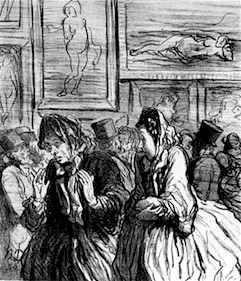
Bookish fine art was beginning criticized for its utilise of idealism, by Realist artists such equally Gustave Courbet, as being based on idealistic clichés and representing mythical and legendary motives while contemporary social concerns were being ignored. Another criticism by Realists was the "simulated surface" of paintings—the objects depicted looked shine, slick, and idealized—showing no real texture. The Realist Théodule Ribot worked against this past experimenting with rough, unfinished textures in his painting.
Stylistically, the Impressionists, who advocated quickly painting outdoors exactly what the eye sees and the hand puts downward, criticized the finished and idealized painting style. Although academic painters began a painting by showtime making drawings and then painting oil sketches of their subject, the loftier smooth they gave to their drawings seemed to the Impressionists tantamount to a lie. After the oil sketch, the artist would produce the final painting with the academic "fini," irresolute the painting to meet stylistic standards and attempting to idealize the images and add perfect item. Similarly, perspective is constructed geometrically on a flat surface and is not really the production of sight; Impressionists disavowed the devotion to mechanical techniques.
Realists and Impressionists also defied the placement of still-life and landscape at the bottom of the bureaucracy of genres. It is of import to notation that near Realists and Impressionists and others amid the early on advanced who rebelled against academism were originally students in academic ateliers. Claude Monet, Gustave Courbet, Édouard Manet, and even Henri Matisse were students under academic artists.
As modern fine art and its avant-garde gained more power, academic fine art was further denigrated, and seen as sentimental, clichéd, conservative, not-innovative, conservative, and "styleless." The French referred derisively to the style of bookish art every bit L'art Pompier (pompier means "fireman") alluding to the paintings of Jacques-Louis David (who was held in esteem by the academy) which often depicted soldiers wearing firewoman-like helmets. The paintings were called "grandes machines" which were said to have manufactured faux emotion through contrivances and tricks.
This denigration of academic fine art reached its elevation through the writings of art critic Clement Greenberg who stated that all bookish fine art is "kitsch." Other artists, such as the Symbolist painters and some of the Surrealists, were kinder to the tradition[ citation needed ]. Every bit painters who sought to bring imaginary vistas to life, these artists were more than willing to learn from a strongly representational tradition. Once the tradition had come to exist looked on as old-fashioned, the allegorical nudes and theatrically posed figures struck some viewers as bizarre and dreamlike.
With the goals of Postmodernism in giving a fuller, more than sociological and pluralistic business relationship of history, academic art has been brought back into history books and discussion. Since the early 1990s, academic fine art has even experienced a limited resurgence through the Classical Realist atelier movement.[four] Additionally, the fine art is gaining a broader appreciation by the public at large, and whereas academic paintings once would but fetch a few hundreds of dollars in auctions, some now fetch millions.[5]
Major artists [edit]
Republic of austria [edit]
Belgium [edit]
Brazil [edit]
Canada [edit]
Republic of croatia [edit]
Czech Republic [edit]
Estonia [edit]
Finland [edit]
France [edit]
| Deutschland [edit]
Republic of hungary [edit]
India [edit]
Ireland [edit]
Italian republic [edit]
Latvia [edit]
Netherlands [edit]
Peru [edit]
Poland [edit]
Russia [edit]
Serbia [edit]
Slovenia [edit]
Kingdom of spain [edit]
Sweden [edit]
Switzerland [edit]
United kingdom [edit]
Uruguay [edit]
|
References [edit]
- ^ a b Myers, Nicole. "Women Artists in Nineteenth–Century France". Metropolitan Museum of Fine art.
- ^ Levin, Kim (November 2007). "Top Ten ARTnews Stories: Exposing the Hidden 'He'". ArtNews.
- ^ Nochlin, Linda. "Why Take There Been No Great Women Artists?" (PDF). Section of Art History, University of Concordia.
- ^ Panero, James: "The New Old School", The New Criterion, Volume 25, September 2006, p. 104.
- ^ Esterow, Milton (1 January 2011). "From 'Riches to Rags to Riches'". ArtNews. Retrieved 12 September 2021.
- ^ "Academism of the 19th Century". www.galerijamaticesrpske.rs. Archived from the original on 21 September 2019. Retrieved 15 August 2019.
Further reading [edit]
- Art and the Academy in the Nineteenth Century. (2000). Denis, Rafael Cardoso & Trodd, Colin (Eds). Rutgers Academy Press. ISBN 0-8135-2795-3
- 50'Fine art-Pompier. (1998). Lécharny, Louis-Marie, Que sais-je?, Presses Universitaires de France. ISBN 2-xiii-049341-6
- L'Art pompier: immagini, significati, presenze dell'altro Ottocento francese (1860–1890). (1997). Luderin, Pierpaolo, Pocket library of studies in fine art, Olschki. ISBN 88-222-4559-8
External links [edit]
-
 Media related to Academic fine art at Wikimedia Commons
Source: https://en.wikipedia.org/wiki/Academic_art
0 Response to "Which Statement Is Not Correct About Academic Art in 19thcentury France?"
Post a Comment